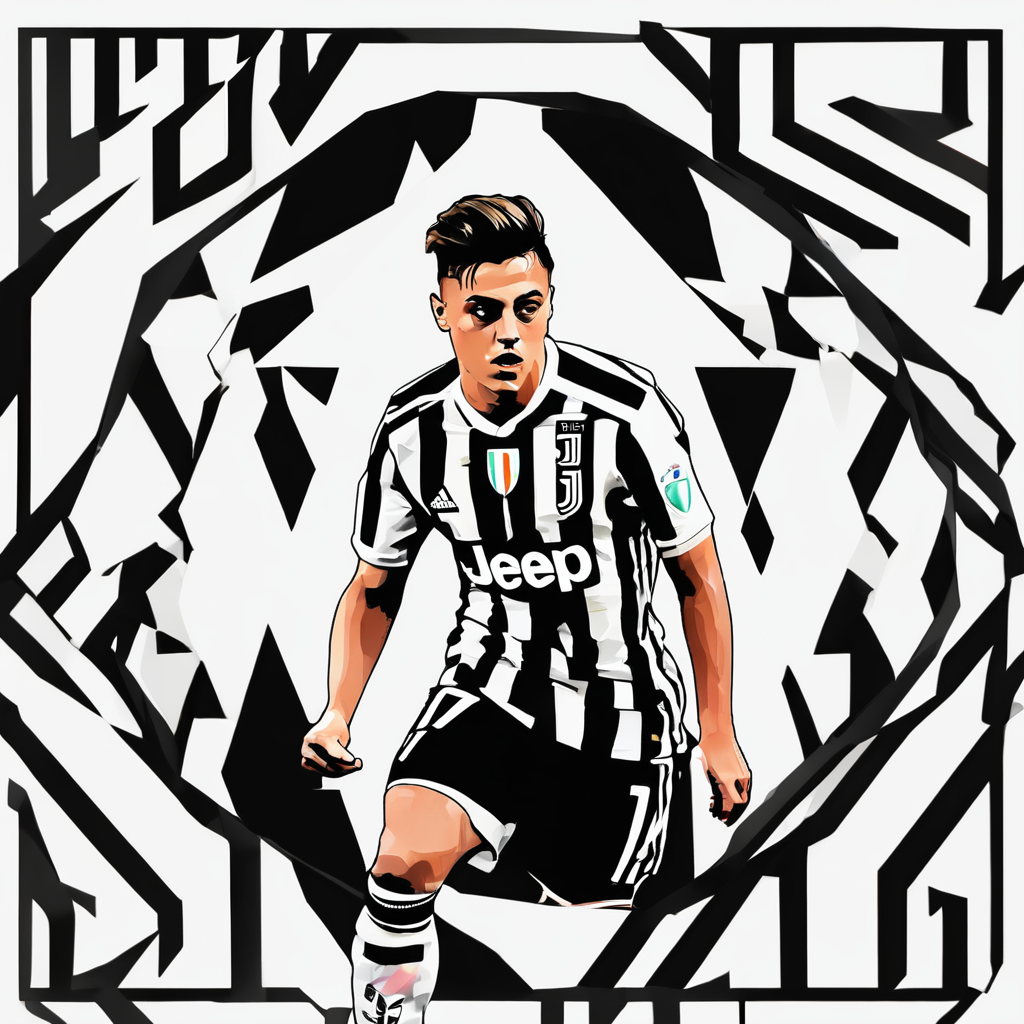

The Milan-Roma match, played at the legendary San Siro stadium during the 10th round of Serie A, offered an unexpected and worrying turn of events for AS Roma. Paulo Dybala, one of the team’s most talented and influential players, injured himself just as he was about to take a penalty. The Argentinian, known for his precision and technique, showed from his very first run-up that he was experiencing unusual discomfort. As he struck the ball, he immediately clutched his leg, leaving the Roma fans in a state of anxiety.
This incident, which could have changed the course of the match that ended 1-0, became the central event of the evening. While Roma hoped to capitalize on this opportunity to equalize, it was ultimately Dybala’s injury that monopolized attention. The penalty was taken, but the price paid was high: the departure of a key player for the team. The unease on the pitch was palpable, the players sensing immediately that the Argentinian would not be able to continue.
The match, refereed by Marco Guida, was fiercely contested, but the incident involving Dybala overshadowed everything else. The San Siro crowd, even amidst the sporting rivalry, reacted with concern, aware of the striker’s unique talent and central role in Serie A. The image of Dybala limping off the pitch will remain one of the most memorable moments of the game. After the match, Roma coach Gian Piero Gasperini quickly made it clear that Dybala’s injury was serious. In his statements reported by Football-Italia, the coach didn’t hide his concern. He described the incident as “the worst moment of the evening,” emphasizing that Dybala’s absence would be a monumental loss for the team.
According to Gasperini, there is “no doubt” that the striker will miss the upcoming matches until the international break. This news immediately sparked a heated debate among fans and observers of Italian football, as Dybala is a key element of Roma’s attacking system. His creativity, game intelligence, and ability to unlock difficult situations are sorely missed whenever he’s not on the pitch.

While the exact duration of his absence remains to be determined, Gasperini’s tone suggests a serious muscle injury. The coach emphasized that further medical examinations will provide a better understanding of the extent of the problem, but the initial verdict is clear: Roma will have to do without their playmaker for several weeks.
The emotion in Gasperini’s words was palpable. The coach, who understands the importance of having technical leaders in a long and challenging season, knows that losing a player of Dybala’s caliber can disrupt the team’s overall balance. For him, this was the “biggest blow” of the evening, far more so than the final result. Paulo Dybala’s unavailability now opens a delicate chapter for AS Roma. The Roman club is experiencing a demanding season, juggling European competitions and the need to remain in contention for the top spots in Serie A. Dybala, often the attacking engine, is a player capable of single-handedly turning the tide of a match. His vision, his formidable left foot, and his ability to create chances where there seems to be almost nothing make him an irreplaceable asset.
Without him, Roma will have to rethink part of their system. Attacking responsibilities could shift to players like Lorenzo Pellegrini, Tammy Abraham, or Stephan El Shaarawy. However, none of them possess the unique combination of creativity and spontaneity that characterizes Dybala. His absence will therefore force Gasperini to adapt his strategy, reinforce certain areas of the pitch, and rely more on the collective. The injury also comes at a critical point in the season. Roma have several important matches to play, particularly against direct rivals for European qualification. In a league as tight as Serie A, the slightest lapse in pace can be costly. The international break could certainly offer some respite, but only if Dybala returns quickly afterward.
For the fans, this news is a shock. Many of them hoped to see Dybala once again become one of the league’s key players, especially after several matches where he had rediscovered his magical form. Now, uncertainty reigns. Fans are waiting to see if Roma can compensate for this absence and if Dybala can return to his best form in the coming weeks. What is certain is that his injury has already left a deep mark on Roma’s season. The missed or converted penalty will never have mattered as much as the temporary loss of one of Serie A’s best players. For Dybala, for Gasperini, and for the entire team, a new challenge begins: that of resilience and attacking rebuilding.


